Team update
The OpenAI team is now 45 people. Together, we’re pushing the frontier of AI capabilities—whether by validating novel ideas, creating new software systems, or deploying machine learning on robots.
Topics: Models

Source feed
1264 items
Stay up to speed on the rapid advancement of AI technology and the benefits it offers to humanity.
The OpenAI team is now 45 people. Together, we’re pushing the frontier of AI capabilities—whether by validating novel ideas, creating new software systems, or deploying machine learning on robots.
Topics: Models

PixelCNNs are a recently proposed class of powerful generative models with tractable likelihood. Here we discuss our implementation of PixelCNNs which we make available at this https URL(opens in a new window). Our implementation contains a number of...
Topics: ModelsInfrastructure
Entities: ModelsInfrastructure
Reinforcement learning algorithms can break in surprising, counterintuitive ways. In this post we’ll explore one failure mode, which is where you misspecify your reward function.
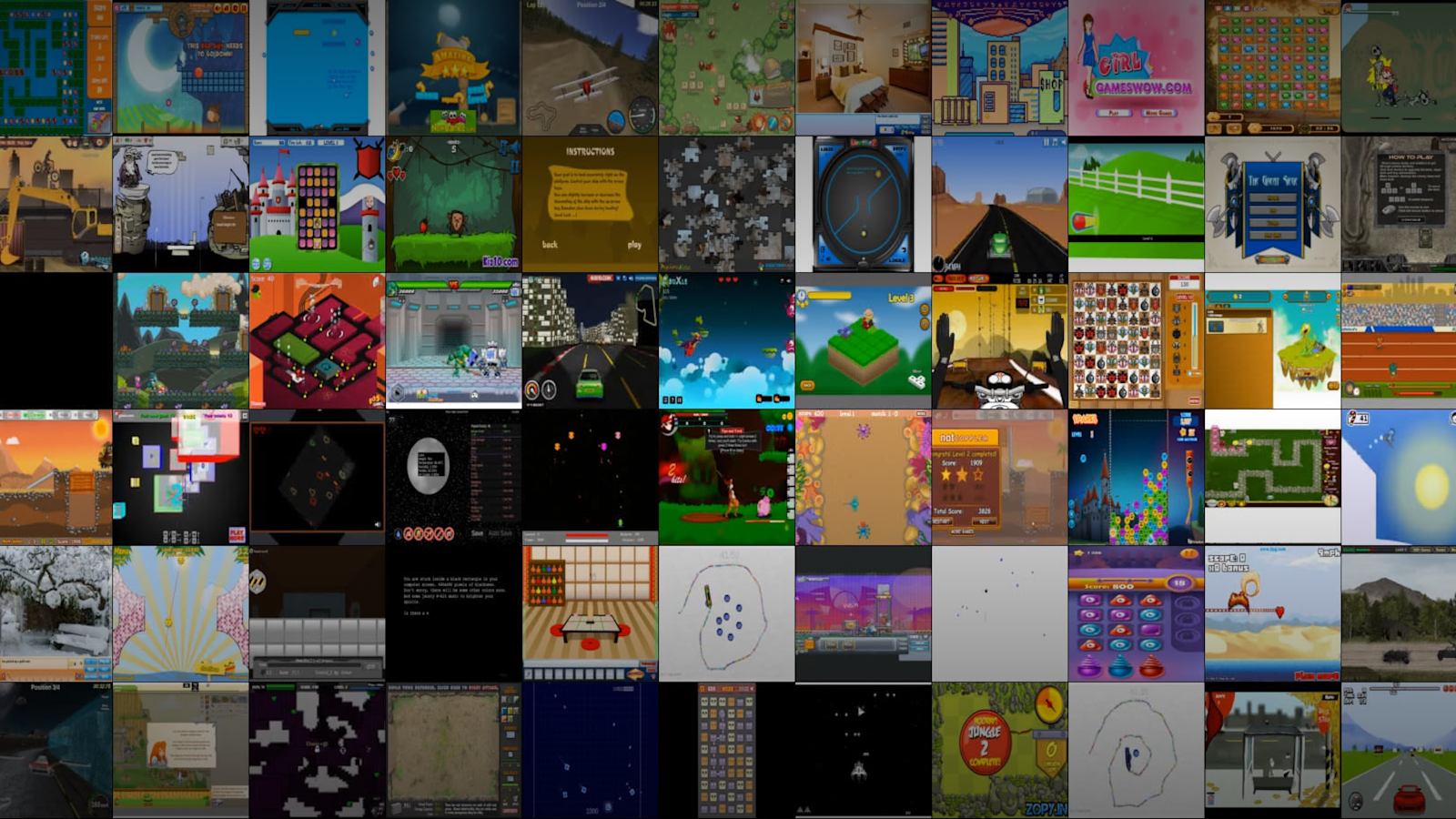
We’re releasing Universe, a software platform for measuring and training an AI’s general intelligence across the world’s supply of games, websites and other applications.
Topics: Infrastructure
Entities: Infrastructure
Count-based exploration algorithms are known to perform near-optimally when used in conjunction with tabular reinforcement learning (RL) methods for solving small discrete Markov decision processes (MDPs). It is generally thought that count-based methods...
We’re working with Microsoft to start running most of our large-scale experiments on Azure.
Topics: Models
The past several years have seen remarkable progress in generative models which produce convincing samples of images and other modalities. A shared component of many powerful generative models is a decoder network, a parametric deep neural net that defines...
Topics: Models
Entities: Models
Generative adversarial networks (GANs) are a recently proposed class of generative models in which a generator is trained to optimize a cost function that is being simultaneously learned by a discriminator. While the idea of learning cost functions is...
Topics: ModelsInfrastructure
Entities: ModelsInfrastructure
Deep reinforcement learning (deep RL) has been successful in learning sophisticated behaviors automatically; however, the learning process requires a huge number of trials. In contrast, animals can learn new tasks in just a few trials, benefiting from their...
Representation learning seeks to expose certain aspects of observed data in a learned representation that's amenable to downstream tasks like classification. For instance, a good representation for 2D images might be one that describes only global structure...
Topics: Models
Entities: Models
The Neural GPU is a recent model that can learn algorithms such as multi-digit binary addition and binary multiplication in a way that generalizes to inputs of arbitrary length. We show that there are two simple ways of improving the performance of the...
Topics: Infrastructure
Entities: Infrastructure
Some machine learning applications involve training data that is sensitive, such as the medical histories of patients in a clinical trial. A model may inadvertently and implicitly store some of its training data; careful analysis of the model may therefore...
Topics: Infrastructure
Entities: Infrastructure