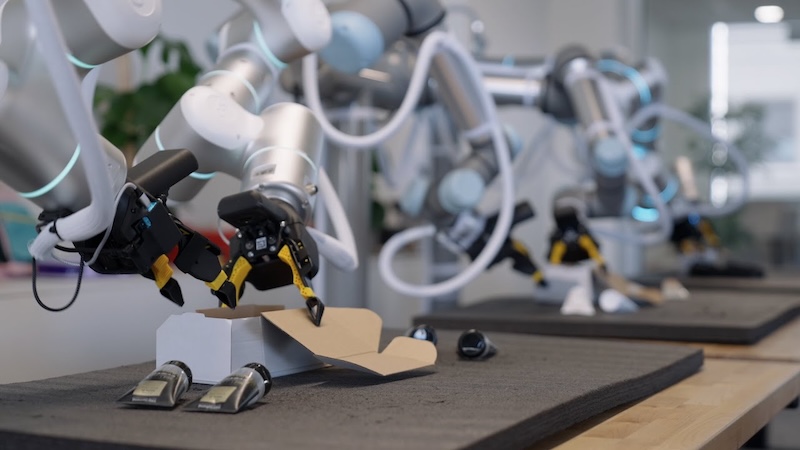
Generalist AI unveils GEN-1 model, claiming breakthrough in real-world robotic task performance
Generalist AI has introduced a new robotics model, GEN-1, which the company says marks a significant step toward general-purpose artificial intelligence for physical tasks. The model is designed as an “embodied foundation model” – a type of AI system that can perceive, reason and act in the physical world – and is trained on large-scale datasets of real-world interactions rather than narrow, task-specific programming. According to the company, GEN-1 achieves “99 percent success rates” on certain tasks, compared with around 64 percent for its previous-generation system, while completing tasks up to three times faster. The system is also described as highly data-efficient, requiring roughly one hour of robot-specific data to adapt to new tasks. “We believe it to be the first general-purpose AI model that crosses a new performance threshold: mastery of simple physical tasks,” the company said in its announcement. Unlike traditional industrial robots, which rely on fixed programming in controlled environments, GEN-1 is designed to operate in more dynamic settings by combining perception, decision-making and motion into a single system. The company defines “mastery” in robotics as a combination of reliability, speed and what it calls “improvisational intelligence” – the ability to adapt to unexpected situations. “In unstructured environments, robots must have the ability to creatively improvise solutions in unexpected scenarios – to respond and adapt rather than rely on predefi...